
Our Purpose
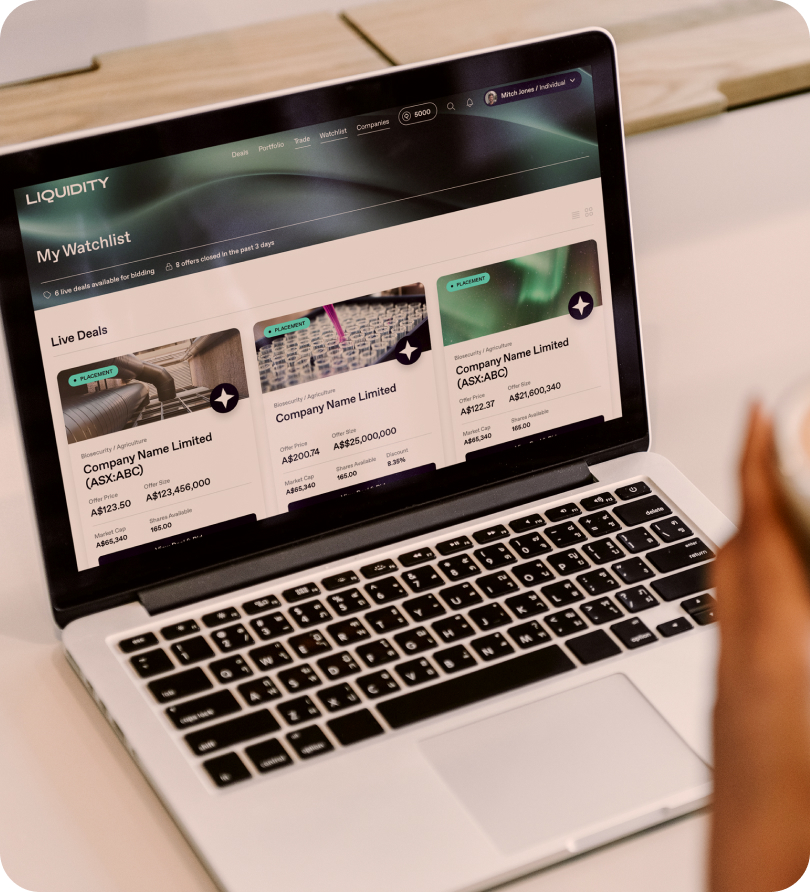
Created specifically for sophisticated investors, enabling them to confidently invest into markets and assets.


Our Team
Board and Management

Bryant Mclarty
Executive Chairman




Chris Nelson
Director & Chief Technical Officer

Kirwan Mactaggart
Associate Advisor
Naomi Harrop
Client Services Manager

Thomas May
Company Secretary

Alex Preston
Software Development Manager
Common Questions
What is a 708 / Sophisticated Investor?
LIQUIDITY offers securities to wholesale clients only. Every investor sits inside one of the exemptions in section 708 of the Corporations Act. People use “708 investor” to mean a sophisticated investor. It is broader than that. Section 708 has several pathways and you only need to meet one. The two most common are :
Sophisticated investor. s708(8)(c) and (d). Net assets of at least $2.5 million, or gross income of at least $250,000 in each of the last two financial years, certified by a qualified accountant. The certificate must be given no more than 6 months before the offer. The same test covers a company or trust controlled by a person who qualifies.
Experienced investor, assessed by a licensee. s708(10). The offer is made through an AFSL holder who is satisfied on reasonable grounds that you have previous experience investing in securities sufficient to assess the offer, the value, the risks, your own information needs and the adequacy of the information provided. The licensee gives you written reasons and you sign an acknowledgment that no disclosure document has been given. There is no wealth test in this pathway.
What it means for you. You receive less information than a retail investor and carry more of the assessment yourself. Wholesale offers are often illiquid, unlisted or early stage. Being wholesale does not mean you are barred from receiving a disclosure document. The issuer simply is not required to give you one. Where we provide an information memorandum or investor pack, the law against misleading or deceptive conduct applies in full.
You do not need 708 status for an IPO. A 708 pathway is only relevant to offers made without regulated disclosure. An IPO is the opposite. It is made under a prospectus lodged with ASIC, so it is open to retail and wholesale investors alike and no certificate or wealth test applies. Where the two meet is the pre-IPO round. That is usually a wholesale only offer under s708, priced below the intended listing price, and it closes before the prospectus is lodged.
Other Pathways can include, Large investment. s708(8)(a) At least $500,000 payable on acceptance. No certificate needed. Professional investor. s708(11) AFSL holders, APRA regulated bodies, super fund trustees with net assets of at least $10 million, listed entities, and anyone who has or controls gross assets of at least $10 million. No certificate needed. Offers to senior managers and their families, and a small number of further exemptions under s708(13) to (21).
What is a Pre-IPO?
A Pre-IPO is an investment opportunity that allows investors to purchase shares in a private company before it goes public. Pre-IPOs can be a risky investment, but they also have the potential to generate significant returns. If you are considering investing in a Pre-IPO, it is important to do your research and understand the risks involved.
Pre-IPOs are typically offered to accredited investors, such as high-net-worth individuals and institutional investors.
What is an IPO?
An initial public offering (IPO) is when a private company sells shares of its stock to the public for the first time. This allows the company to raise money from a wider pool of investors and become a publicly traded company.
Going public can be a major milestone for a company, and it can offer a number of benefits. For example, an IPO can help a company raise capital to fund growth, expand its operations, or make strategic acquisitions.
What is a Seed Investment?
Seed investments are a critical source of capital for early-stage startups. They provide the funding that startups need to get off the ground and start growing. Seed investors can also provide valuable mentorship and guidance to help startups succeed.
There are many benefits to getting a seed investment. First, it can provide the capital that startups need to build their product or service, hire employees, and market their business. Seed Investments also usually occur at low valuations creating the potential to generate significant returns.
Seed Investments are often high-risk investments. This is because startups are young and unproven, and there is a risk that they may not succeed.
What is “Direct Settlement”?
Direct Settlement involves you (the investor) paying money directly to the company you are investing in either by BPAY or EFT.
Your shares are then delivered directly into your Liquidity account on the settlement date.
What is “DVP Settlement”?
Delivery Versus Payment Settlement (DVP) is a securities settlement method that guarantees the transfer of securities only happens after payment has been made. DVP stipulates that the buyer’s cash payment for securities must be made prior to or at the same time as the delivery of the security.
What are Liquidity Dollars?
Liquidity Dollars are our way of giving back to you for Investing in companies through Liquidity.
Unlike other capital raising houses, we give back a portion of the capital raising fee to you in the form of Liquidity Dollars.
Liquidity Dollars can be: redeemed for cash to offset your brokerage, be rolled in to future deals on Liquidity, or be utilised for premium products and experiences.
What is a HIN?
A HIN, or Holder Identification Number, is a unique number that is issued by the Australian Securities Exchange (ASX) to identify you as a CHESS sponsored shareholder. CHESS is the Centralised Clearing House Electronic Settlement System, which is a system that records all share ownership in Australia.
When you open a Liquidity account you obtain your own HIN to hold your stock securely, with you as the secure holder and owner.
How do I invest in a deal on Liquidity?
Once you have an active Liquidity account you will be notified when a deal that suits your investment interests is open for applications.
You can then view a dedicated company page that details the company to you and the terms of the deal.
If you want to make a bid, it’s just a few clicks away! We will then contact you with your allocation before the deal is settled either directly via DVP and your stock will be issued.
What is a Macquarie CMA Account?
Macquarie Cash Management Account’s (CMA) are a type of bank account designed with investors in mind. They offers a number of features that are not available with traditional bank accounts.
What is a Convertible Note?
A convertible note is a type of debt instrument that can be converted into equity at a later date. It is a popular financing option for startups and early-stage companies because it allows them to raise capital quickly and easily without having to go through the lengthy and expensive process of issuing traditional equity.